A needlestick or sharps injury happens when a needle, scalpel, blade, broken glass or another sharp object punctures or cuts the skin.
Some sharps injuries are relatively minor wounds. However, if the sharp may be contaminated with blood or certain body fluids, there is also a potential risk of exposure to blood-borne viruses such as hepatitis B, hepatitis C and HIV.
Prompt first aid and urgent medical assessment are therefore important after a potentially contaminated sharps injury.
This guide explains what to do immediately after a needlestick injury, what not to do, how blood splashes to the eyes or mouth should be managed, when occupational health or emergency medical advice is needed, and what UK employers should consider when workers may be exposed to sharps.
What is a needlestick or sharps injury?
A sharps injury occurs when a sharp object penetrates or cuts the skin.
Examples include injuries involving:
hypodermic needles;
syringe needles;
lancets;
scalpels;
suture needles;
medical blades;
broken glass;
other contaminated sharp instruments.
HSE also uses the term percutaneous injury for an injury where a needle, blade or other sharp medical instrument penetrates the skin.
Why can a needlestick injury be serious?
The main concern following an injury with a potentially blood-contaminated sharp is exposure to a blood-borne virus.
The blood-borne viruses of particular concern include:
hepatitis B (HBV);
hepatitis C (HCV);
human immunodeficiency virus (HIV).
Not every needlestick injury results in infection. The actual risk depends on several factors, including the type of sharp, whether it was contaminated, the type and amount of body fluid involved, how deeply the skin was penetrated and the exposed person's immunity or vaccination status.
Even when the eventual infection risk is low, the exposure still requires appropriate assessment rather than being dismissed as an ordinary small puncture wound.
What should you do immediately after a needlestick injury?
Step
What to do
Why it matters
1. Stop the activity
Move away from the sharp and make sure there is no further risk of injury.
Prevents another exposure.
2. Encourage gentle bleeding
Allow the puncture wound to bleed gently, ideally under running water.
This forms part of HSE's immediate first aid advice following potentially contaminated sharps exposure.
3. Wash the wound
Wash thoroughly with running water and plenty of soap.
Helps remove contamination from the skin and wound area.
4. Do not scrub or suck
Do not aggressively scrub the wound and never suck it.
These actions are not recommended and may damage tissue or increase exposure.
5. Cover it
Dry the area and cover it with a waterproof plaster or dressing.
Protects the wound after first aid.
6. Seek urgent medical assessment
Contact occupational health or another appropriate clinical service without unnecessary delay.
Risk assessment and time-sensitive post-exposure treatment may be required.
7. Report the incident
If it happened at work, report it through the organisation's sharps or exposure procedure.
The incident needs to be assessed, recorded and followed up appropriately.
Should you squeeze a needlestick wound?
The wound should be gently encouraged to bleed.
HSE guidance does not recommend aggressively squeezing or damaging the tissue.
Ideally, allow gentle bleeding while holding the area under running water, then wash the wound thoroughly with soap and water.
Should you scrub a needlestick wound?
No.
HSE guidance specifically says not to scrub a needlestick or puncture wound while washing it.
Use plenty of soap and running water, but avoid aggressive rubbing that could damage the skin further.
Should you suck a needlestick wound?
No.
Never suck a puncture or needlestick wound.
This does not provide useful first aid and can create another potential route of exposure through the mouth.
Should you use bleach or disinfectant inside the wound?
No.
Do not pour bleach, strong disinfectant or other harsh chemicals into a needlestick wound.
The recommended immediate first aid is gentle bleeding followed by washing with running water and plenty of soap.
What should you cover the wound with?
After the wound has been washed:
dry it gently;
cover it with a waterproof plaster or suitable waterproof dressing;
avoid unnecessary handling of the wound.
The dressing protects the broken skin after first aid while medical assessment is arranged.
Do you need medical attention after every contaminated needlestick injury?
A potentially contaminated needlestick or puncture injury should receive urgent clinical assessment.
HSE guidance says that following a needlestick or puncture wound, an appropriate clinician should assess:
whether the exposure could transmit a blood-borne virus;
what type of exposure occurred;
whether further testing is required;
whether post-exposure treatment is appropriate;
whether follow-up monitoring is required.
Depending on the workplace, assessment might be provided through:
occupational health;
an emergency department;
infectious diseases services;
sexual health or genitourinary medicine services;
another designated clinical service.
Do not wait for symptoms to appear before reporting a potentially significant exposure.
Why is urgent assessment important?
Some post-exposure treatments are time-sensitive.
A clinician may need to consider:
hepatitis B vaccination status;
whether hepatitis B post-exposure treatment is indicated;
whether HIV post-exposure prophylaxis is appropriate;
baseline blood tests;
follow-up blood tests;
the source and type of exposure.
These decisions should be made by appropriately qualified healthcare professionals rather than by the casualty or workplace first aider.
What is post-exposure prophylaxis?
Post-exposure prophylaxis, often shortened to PEP, means treatment given after a potential exposure in an attempt to prevent an infection developing.
The need for PEP depends on the particular exposure.
For example, clinicians may consider:
hepatitis B vaccination or other hepatitis B management;
HIV post-exposure prophylaxis where clinically indicated.
There is currently no equivalent preventive PEP treatment routinely used to prevent hepatitis C after an exposure, but testing and clinical follow-up may be required.
Do not take medication belonging to someone else or attempt to manage post-exposure treatment yourself.
What information will the clinician need?
Be prepared to explain:
what type of sharp caused the injury;
whether it had been used;
whether blood was visible;
how deeply it penetrated;
which part of the body was injured;
when the injury happened;
whether the sharp was hollow-bore or solid;
what is known about the source of the blood or body fluid;
your hepatitis B vaccination status if known.
Do not delay urgent assessment simply because some of this information is unavailable.
Should you keep the needle for testing?
No.
HSE says it is not necessary to keep the needle or other sharp instrument to send it for laboratory testing.
Retaining or handling it again creates an additional sharps risk.
The sharp should not be re-sheathed or re-capped and should be disposed of safely in an appropriate sharps container by someone following the correct procedure.
Should you recap a used needle?
In general, used needles should not be re-sheathed or re-capped.
HSE recommends disposing of sharps immediately into an appropriate sharps container after use.
If a particular clinical process genuinely requires recapping, this should be specifically risk assessed and suitable control measures should be used.
What if blood splashes into the eye?
A sharps injury is not the only way someone can be exposed to potentially contaminated blood or body fluids.
Blood can also enter through the mucous membranes of the:
eyes;
nose;
mouth.
If blood or potentially infectious body fluid gets into the eye, HSE advises washing it copiously with water.
Then report the exposure and obtain urgent clinical assessment according to the workplace procedure.
Report the incident and obtain appropriate medical assessment because blood exposure to a mucous membrane can be relevant to blood-borne virus risk.
What if blood gets onto intact skin?
Intact, undamaged skin provides an effective barrier against blood-borne virus transmission.
Wash contaminated skin thoroughly using soap and water.
Risk becomes more important where blood contacts:
cuts;
abrasions;
eczema;
broken or damaged skin;
eyes, nose or mouth.
What if blood reaches an existing cut?
If potentially contaminated blood contacts broken skin:
wash the area thoroughly with soap and running water;
do not scrub damaged skin aggressively;
cover the wound appropriately;
report the exposure;
obtain urgent clinical advice.
Which blood-borne viruses are associated with sharps injuries?
Virus
Why it matters after sharps exposure
Hepatitis B
Can be transmitted through infected blood. Vaccination is available and is recommended for some occupational risk groups.
Hepatitis C
Can be transmitted through infected blood. Clinical assessment and follow-up testing may be required following significant exposure.
HIV
Can be transmitted through infected blood. A clinician may assess whether HIV post-exposure prophylaxis is required.
Does every used needle carry HIV?
No.
A used needle does not automatically mean that HIV or another blood-borne virus is present.
For transmission to occur, several factors have to align, including contamination with infectious blood and sufficient exposure.
However, a potentially contaminated sharps injury should still be medically assessed because the actual risk cannot be judged simply by looking at the needle.
Are hollow-bore needles higher risk?
HSE notes that sharps injuries involving hollow-bore needles can present a higher risk because they can retain blood inside the needle.
Examples include needles used for:
venepuncture;
injections;
intravenous cannulation;
blood collection.
This is one reason clinicians ask what type of sharp caused the injury.
What about a discarded needle found outdoors?
Discarded needles may be found in:
parks;
public toilets;
derelict buildings;
car parks;
waste areas;
streets;
playgrounds;
other public spaces.
Do not pick up discarded needles with bare hands.
HSE advises members of the public not to handle discarded needles and to inform the relevant local authority so appropriate clinical-waste collection can be arranged.
What if you accidentally stand on or touch a discarded needle?
If the needle actually punctures the skin:
allow the wound to bleed gently;
wash it thoroughly with running water and soap;
do not scrub or suck it;
cover it with a waterproof dressing;
seek urgent medical advice.
Tell the clinician that the injury involved a discarded needle and provide as much information as possible about where and how it happened.
Should you take a discarded needle to hospital?
No.
Do not carry a discarded needle to a hospital, GP surgery or pharmacy after an exposure.
HSE states that the sharp itself does not need to be sent for laboratory testing.
Handling it again can create an unnecessary second exposure.
How should discarded needles be removed in the workplace?
Workers who are expected to deal with discarded sharps should have appropriate:
training;
risk assessment;
equipment;
sharps containers;
disposal procedures;
PPE.
Depending on the work, suitable retrieval equipment can include:
tongs;
pincer tools;
litter pickers;
other tools that keep hands away from the sharp.
Sharps should be placed directly into a suitable sharps container rather than an ordinary plastic sack or general-waste bin.
Who is at increased occupational risk?
Needlestick and sharps injuries are particularly associated with healthcare, but many other workers can be exposed.
Examples include:
doctors and nurses;
dentists and dental staff;
care workers;
paramedics and emergency workers;
laboratory staff;
cleaners;
waste and recycling workers;
street-cleaning staff;
tattoo and body-piercing workers;
beauty and cosmetic-treatment workers;
chiropody and podiatry workers;
construction workers in contaminated or derelict buildings;
police and prison staff;
vehicle recovery and repair workers who may encounter discarded sharps.
Needlestick injuries in healthcare
Healthcare workers can be exposed during:
injections;
blood collection;
cannulation;
surgery;
handling instruments;
disposing of used sharps;
cleaning or processing equipment.
Healthcare organisations are subject to specific requirements concerning the safe use and disposal of medical sharps in addition to general health and safety law.
Needlestick injuries in care homes and social care
Social-care workers may encounter needles used for insulin, injectable medicines or other healthcare procedures.
Organisations should ensure:
safe sharps containers are available;
workers understand disposal procedures;
needles are not left in bedding or ordinary waste;
staff know what to do after an exposure;
urgent clinical advice can be accessed when needed.
Cleaners may unexpectedly encounter discarded sharps in:
toilets;
hotel rooms;
public buildings;
bins;
changing rooms;
accommodation;
outdoor spaces.
Workers should never be expected to place their hands blindly into bags, bins, bedding or other areas where a hidden sharp may be present.
Employers should assess whether suitable tools, gloves, procedures and sharps containers are necessary.
Needlestick injuries in waste and recycling work
Waste and recycling workers can be injured by needles hidden inside sacks or mixed waste.
Risk controls can include:
avoiding manual handling of loose sharps;
using suitable retrieval tools;
wearing suitable gloves;
using approved sharps containers;
training workers to recognise and report discarded sharps;
having a clear post-exposure procedure.
Needlestick injuries on construction sites
Construction workers may find needles when working in:
derelict buildings;
vacant properties;
areas associated with drug use;
refurbishment projects;
demolition sites.
HSE advises treating found needles as potentially contaminated and controlling the risk through suitable procedures, tools, PPE and sharps disposal arrangements.
What should employers do before an injury happens?
Where sharps exposure is foreseeable, employers should not rely on first aid alone.
Risk control should consider:
whether sharps can be avoided;
whether safer-sharps technology can be used;
how sharps are handled;
how and where they are disposed of;
whether suitable PPE is required;
worker training;
emergency first aid arrangements;
how exposure incidents will be reported;
how urgent occupational-health or clinical assessment will be accessed;
what post-exposure treatment may be available.
What are safer sharps?
Safer sharps are devices designed to reduce the likelihood of accidental needlestick injury.
Depending on the procedure, these may include:
retractable needles;
shielded needles;
safety cannulae;
needle-free systems;
protected lancets;
other engineered safety devices.
Where sharps cannot be eliminated, employers should consider whether safer equipment can reduce the risk.
Why should sharps containers be close to the point of use?
A used needle becomes more hazardous when it has to be carried around before disposal.
Sharps containers should therefore be suitably positioned so used sharps can be discarded promptly.
Used needles should not be left:
on worktops;
on beds;
inside ordinary waste;
in pockets;
on trays for later disposal.
Should sharps bins be overfilled?
No.
Sharps containers should be used according to their instructions and should not be filled beyond their designated limit.
An overfilled sharps container increases the chance of contact with protruding needles or other contaminated instruments.
Do gloves prevent needlestick injuries?
Ordinary disposable gloves help protect against blood and body-fluid contamination but should not be assumed to stop a needle penetrating the skin.
Some work may require more protective gloves or engineered controls, depending on the risk assessment.
The most effective approach is to prevent contact with the sharp in the first place.
Do healthcare workers need hepatitis B vaccination?
Hepatitis B vaccination is recommended for certain people whose work puts them at occupational risk of contact with blood or blood-contaminated body fluids.
Whether vaccination is indicated depends on the person's work and should be managed through appropriate occupational-health arrangements.
Workers should know how to access their vaccination records because hepatitis B immunity may be relevant during post-exposure assessment.
Should a needlestick injury be recorded at work?
Yes.
Workplace exposure incidents should be reported and recorded according to the organisation's procedures.
The record may include:
when the incident occurred;
where it happened;
what sharp was involved;
what task was being performed;
which part of the body was injured;
what immediate first aid was provided;
what clinical follow-up was arranged;
how the exposure occurred;
whether controls need to be changed.
The purpose is not merely paperwork. Incident review may identify a preventable problem with equipment, training, disposal or working practices.
Not every needlestick injury is automatically reportable under RIDDOR.
HSE identifies circumstances in which reporting may be required, including where:
an employee is injured by a sharp known to be contaminated with a blood-borne virus, which may be reportable as a dangerous occurrence;
the worker later develops a blood-borne disease attributable to the exposure;
the injury itself meets another RIDDOR reporting threshold.
If the sharp is not known to be contaminated, or the source cannot be traced, the injury is not automatically reportable solely because it was a needlestick injury.
Employers should assess the circumstances against current HSE RIDDOR guidance.
What should happen after the immediate medical assessment?
Depending on the exposure, follow-up may involve:
blood tests;
review of hepatitis B vaccination status;
post-exposure medication where indicated;
repeat testing at specified intervals;
occupational-health review;
psychological support if the exposure causes significant anxiety.
Follow the clinician's instructions carefully and attend any recommended follow-up appointments even if you feel completely well.
Do blood-borne virus infections cause immediate symptoms?
Not necessarily.
A person may feel completely well after exposure.
This is why decisions about testing and treatment are based on the nature of the exposure rather than on whether symptoms appear immediately.
What if the source person's infection status is unknown?
Do not assume there is no risk simply because the source is unknown.
Equally, do not assume infection has occurred.
A clinician will assess the circumstances of the exposure and decide what testing, treatment or follow-up is appropriate.
Do not attempt to obtain private medical information about another person outside the correct clinical or workplace process.
What if the needle looks old or has been outdoors?
The appearance or age of a discarded needle cannot reliably tell you whether medical assessment is necessary.
HSE notes that the blood-borne virus transmission risk from a discarded needle in the community is generally extremely low, but a puncture exposure should still receive appropriate clinical assessment rather than being self-diagnosed.
Needlestick injuries and tetanus
A puncture wound may also prompt assessment of tetanus protection, particularly where a discarded or contaminated sharp is involved.
Tell the clinician when you last received a tetanus vaccination if you know.
Do not delay medical assessment while trying to find vaccination records.
What should first aiders do?
A workplace first aider can help with the immediate wound care, but should not attempt to calculate the casualty's infection risk or decide whether PEP is required.
The first aider can:
help encourage gentle bleeding;
provide access to soap and running water;
provide a waterproof plaster or dressing;
help the worker report the incident;
help arrange urgent occupational-health or clinical assessment;
record first aid provided according to workplace procedures.
Medical risk assessment belongs with an appropriately qualified clinician.
What first aid supplies are useful for sharps injuries?
General supplies can include:
disposable gloves;
waterproof plasters;
sterile dressings;
access to soap and running water;
eye-irrigation facilities where splash exposure is foreseeable.
Workplaces with sharps risks may additionally require suitable:
sharps containers;
retrieval tools;
specialist PPE;
safer-sharps devices;
occupational-health arrangements.
A general first aid kit does not replace a dedicated sharps-control system or post-exposure procedure.
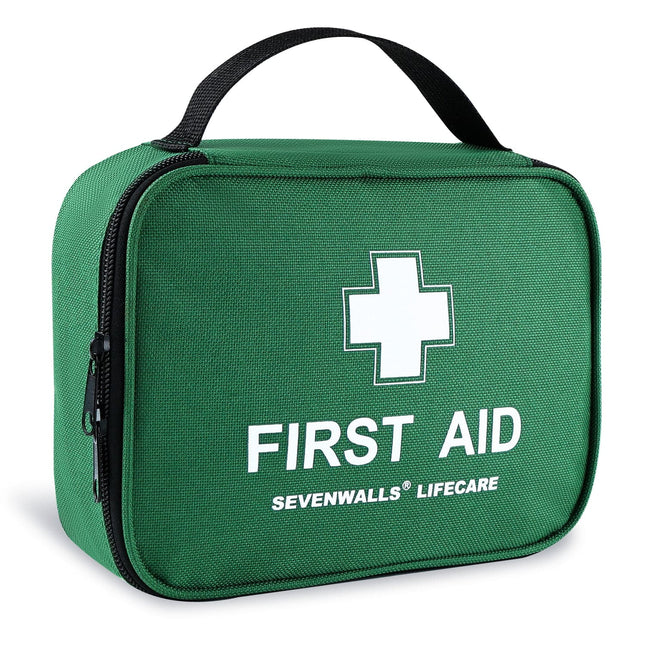
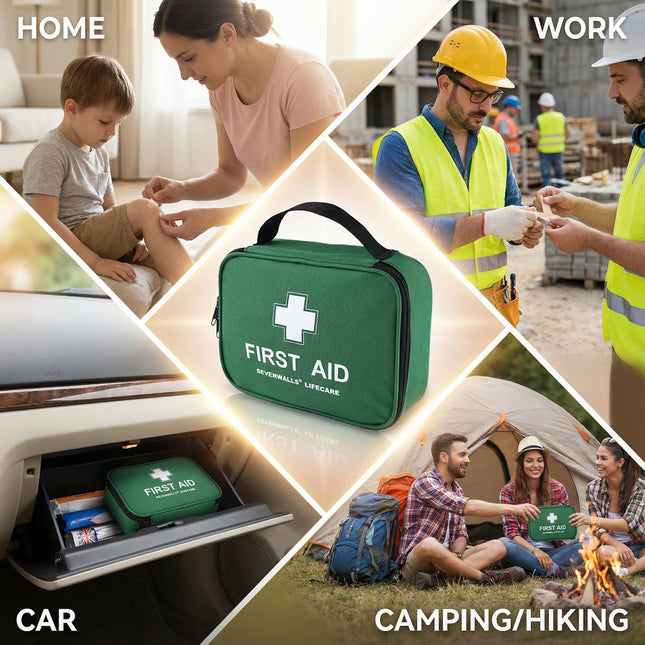
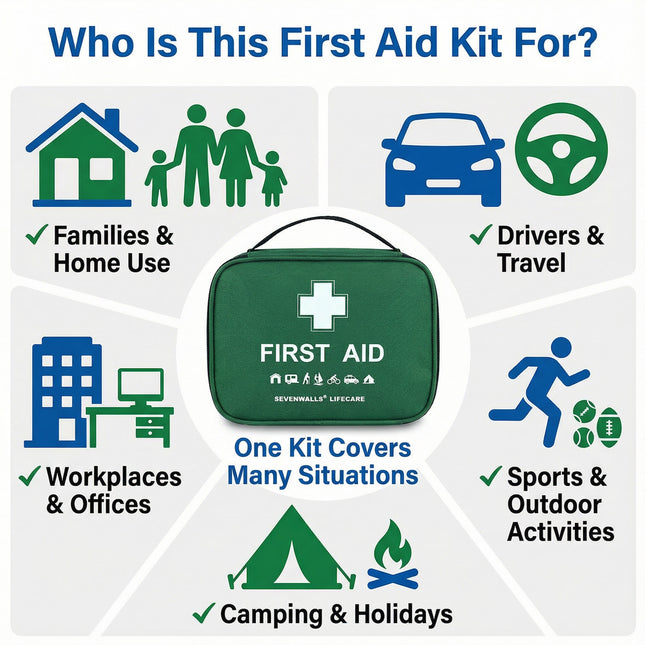
You can view our range of first aid kits when reviewing general workplace first aid provision.
Common mistakes after a needlestick injury
Common mistakes include:
ignoring a small puncture because it barely bled;
aggressively squeezing the wound;
scrubbing the wound;
sucking the wound;
pouring bleach or harsh disinfectant into it;
waiting for symptoms before seeking advice;
keeping or carrying the needle to hospital for testing;
A needlestick injury may leave only a tiny puncture wound, but if the sharp could have been contaminated with blood or body fluids, the potential infection risk means it should be taken seriously.
Encourage the wound to bleed gently, wash it thoroughly with soap and running water, do not scrub or suck it, and cover it with a waterproof dressing.
Potentially significant exposures should then receive urgent occupational-health or clinical assessment so the risk can be evaluated and any time-sensitive post-exposure treatment considered.
At work, every sharps exposure should also trigger a review of how the injury happened. Good prevention depends on safe handling, suitable sharps containers, safer equipment where appropriate, worker training and a clear emergency procedure that allows rapid access to specialist medical advice.
Needlestick & Sharps Injuries — FAQ
What should you do immediately after a needlestick injury?
Encourage the wound to bleed gently, ideally under running water. Wash it thoroughly with running water and plenty of soap, do not scrub or suck the wound, then dry it and cover it with a waterproof plaster or dressing. Seek urgent medical assessment if the sharp may have been contaminated.
Should you squeeze a needlestick wound?
The wound should be gently encouraged to bleed, but it should not be aggressively squeezed or damaged. Wash it thoroughly with soap and running water afterwards.
Can a needlestick injury transmit HIV or hepatitis?
Potentially, if the sharp was contaminated with infected blood. The blood-borne viruses of greatest concern include hepatitis B, hepatitis C and HIV. Not every sharps injury leads to infection, so urgent clinical assessment is used to evaluate the actual risk.
Should you take the needle to hospital for testing?
No. HSE states that it is not necessary to keep a needle or sharp instrument for laboratory testing. Handling it again creates another sharps risk. It should be disposed of safely through the appropriate sharps procedure.
What should you do if blood splashes into your eye?
Wash the eye copiously with water and report the exposure. Obtain urgent occupational-health or clinical advice so the potential blood-borne virus exposure can be assessed.
Do all needlestick injuries need to be reported under RIDDOR?
No. Not every sharps injury is automatically RIDDOR-reportable. Reporting may be required where the sharp is known to be contaminated with a blood-borne virus, where the worker later develops a disease attributable to the exposure, or where the injury meets another RIDDOR reporting threshold.
What should you do if you find a discarded needle?
Do not handle a discarded needle with bare hands. Members of the public should inform the appropriate local authority or responsible organisation so it can be collected safely. Workers expected to remove sharps should use their trained procedure, suitable tools and an appropriate sharps container.
1-2 days delivery
FirstAidKitsUK offers free delivery on all UK orders via Royal Mail 48 Tracked. We offer free next-day delivery on all orders over £30 via Royal Mail 24 Tracked.
Royal Mail 48 Tracked: Orders placed before 16:00 pm are dispatched the same day Mon-Fri, and 11:00 pm Sat. Orders after this threshold will be dispatched the next working day. Delivery takes 2 days, including Saturdays. This service is free for all orders.
Royal Mail 24 Tracked: Orders placed before 16:00 pm Mon-Fri, before 11pm Saturday are dispatched the same day. Orders after this threshold will be dispatched the next working day. Delivery will take place the next working day. This service is free for orders over £30. The charge for this service is £3.99 for orders under £30.
This may not be available during public holidays or weekends in between public holidays.